Why Does My Back Hurt More Sitting Than Standing? You Are Not Imagining It
Warning signs first, then what sitting does to your lower back, what it cannot explain and what to change, in order.


Key takeaways
- A review found more disc pressure sitting than standing, but the few recent studies found no difference.
- Disc pressure readings vary a lot and do not tell you why your own back hurts.
- OSHA says working in the same posture for long periods is not healthy, however good the posture.
- Get up at least every 30 minutes, or take calls and meetings on your feet.
- Back pain with pain, tingling, weakness or numbness in both legs, or bladder or bowel changes, needs emergency care.
People often report tighter back muscles with prolonged sitting, and OSHA says holding one posture for long periods is not healthy, even a good one. For the ache alone, get up at least every 30 minutes. Back pain with pain, tingling, weakness or numbness in both legs, bladder or bowel changes, or after a serious accident needs emergency care.
Why does your back hurt more sitting than standing?
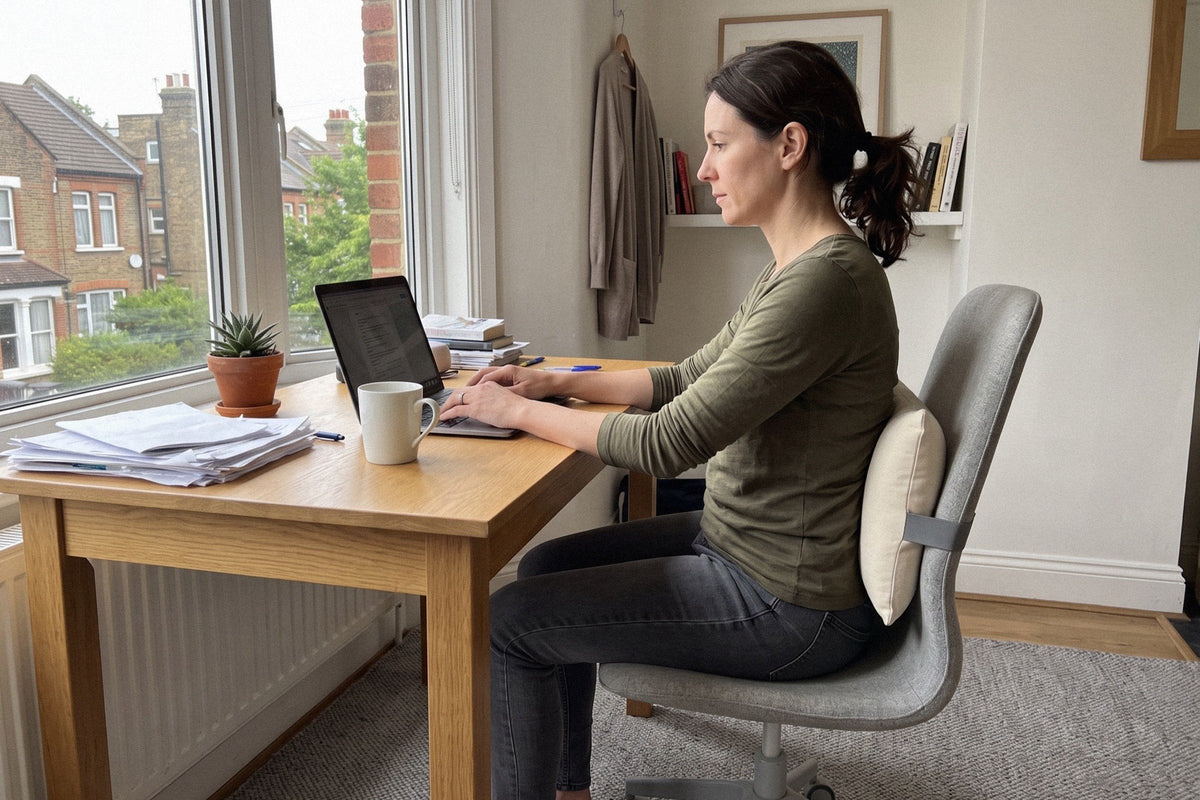
Back pain that is worse sitting than standing is a pattern, not an explanation: an ache in the lower back that builds the longer you stay in a chair and eases once you stand up and move. It tends to arrive the same way. You settle in after lunch, sitting well, not even slouching, and a while later the ache is there. By evening your back feels tight and stiff. Then you stand, walk to the kitchen, and it fades soon after.
You are not imagining the difference. Harvard Health's page on sitting and back pain puts it plainly: "for many people, sitting for any length of time is painful."1 It is just as plain about the limit: "the specific reason for back pain often cannot be identified."1
In brief: a review of studies in living people found more pressure inside the lower-back discs when sitting than when standing, though the few recent studies found no difference. OSHA, the US workplace safety agency, says working in the same posture for long periods is not healthy, however good the posture. The details come after the warning signs, and nothing in this guide replaces asking a health professional.
If your ache is worst right after you get out of bed rather than after hours in a chair, that is a different pattern, with its own guide: lower back pain that is worst in the first hour after waking.
When is a sore back more than a sitting problem?
If the ache shows up every afternoon, it is tempting to blame the desk and stop there. Check these signs before anything about discs or chairs, because they change what you do next.
Get emergency care
The NHS, the UK's health service, sends you to emergency care if you have back pain and:2
- Pain, tingling, weakness or numbness in both legs.
- A loss of feeling around your genitals or anus.
- Changes in your bladder or bowels, such as trouble peeing or losing control of either.
- Changes in how your genitals feel during sex, or in your sexual function.
- Chest pain.
- Pain that started after a serious accident, such as a car accident.
Do not drive yourself. Ask someone to drive you, or call for an ambulance.2
Get care right away
Get care right away if you have back pain and:2
- You feel hot, cold, shivery or generally unwell.
- The pain is severe and started suddenly, or it is getting worse quickly.
Ask a health professional
Ask a health professional if you have back pain and:2
- It has not improved after a few weeks of caring for it at home.
- It does not improve after resting, or it is worse at night.
- It keeps you from your day-to-day activities.
- You are worried about the pain or struggling to cope.
- You have lost weight without trying to.
- There is a lump or swelling in your back, or your back has changed shape.
- It is worse when you sneeze, cough or strain.
- It comes from the top of your back, between your shoulders, rather than your lower back.
If standing or walking is what hurts more for you, the sitting research in this guide does not cover that pattern, so ask a health professional rather than guess at a reason. When you are unsure which list a sign belongs to, act on the more urgent one.
 Desk & OfficeMorncrest® Seat Cushion & Lumbar Support Set
$89
What does sitting do to your lower back?
Is sitting a rest for your back or not? It feels like one. You are off your feet, not lifting or twisting, and still the ache builds. Part of that question has been measured by recording the pressure inside the discs of the lower back.
Li and colleagues pooled those measurements in a review of studies done in living people, and found the pressure inside the lower-back discs higher when sitting than when standing.3 But the authors write that such studies "are relatively few." When they split the studies by era, the ones done after the 1990s showed no difference between sitting and standing. Only 21 participants took part in those newer studies, so the authors say to read that no-difference result with caution.3 They add that the measure varies a lot, even inside one study, and that the same people may appear in more than one paper by the same authors. The review was funded by a university, and its authors declare no competing interests.3
The muscles are a separate thread, and Harvard Health's page keeps both sides of it in one sentence: there "isn't proof from medical studies that sitting leads to more spasms," yet "people often report tighter and more painful back muscles with prolonged sitting."1 That may sound like your stiffness by evening, but the page presents it as something people report.
The disc review had a narrow aim: it compared pressure in the two postures, not pain.3 We read it this way: if the difference holds, it may help explain why a chair can feel harder on the back than standing for some people. It cannot tell you why your own back aches, and nothing here measured your back.
Why does it still hurt when you sit up straight?
"Sit up straight" is the advice you hear most. Maybe you already do, back held off the backrest, shoulders level, and your back still aches by afternoon. That is not a failure on your part. The guidance written for desk work describes more than one good way to sit.
OSHA's page, written for computer workstations, describes a supported back this way: "Back is fully supported with appropriate lumbar support when sitting vertical or leaning back slightly."4 It then shows sitting upright, sitting reclined, sitting with the thighs sloping down, and standing, and says they "all provide neutral positioning for the body."4 Sitting bolt upright is one good position, not the only one.

OSHA's page also says: "Regardless of how good your working posture is, working in the same posture or sitting still for prolonged periods is not healthy."4
To us, chasing one perfect posture misses OSHA's point. Sitting straight with your back held off the backrest is one more posture to hold, and holding any posture for long periods is what the page warns about. So the first change is not a better posture. It is time: how long you stay in any one position.

How often should you get up from your desk?
You have heard "take breaks" before, and maybe you cannot get up every hour at work. The guidance below asks you to move more often than that, but each change is small, and some happen at the desk.
Harvard Health's page says, "whenever possible, avoid prolonged sitting." For desk work it is specific: get up periodically, "at least every 30 minutes," and walk around, for example to get a drink of water or to pick up your mail.1 You already make those trips, just not that often.
When work keeps you near the desk, OSHA's page says, "You should change your working position frequently throughout the day," and these are among the ways it lists:4
- Make small adjustments to your chair or backrest.
- Stand up and walk around for a few minutes periodically.
- Perform some of your tasks in standing: computing, reading, phone, meetings.

In one small study, Thorp and colleagues had 23 office workers with a higher body weight spend two blocks of five working days in a simulated office.5 In one block they sat; in the other they alternated sitting and standing every 30 minutes at a height-adjustable desk. On the last day of each block they rated their own discomfort, and lower-back discomfort came out 31.8 percent lower on the alternating days.5
That result comes with limits: one small group, a lab office rather than their own, five days per block, self-rated discomfort on a single day, a sit-stand desk not everyone has, and an abstract that names no funder. They also rated their concentration higher on the seated days.5
NHS advice is to "stay active and try to continue with your daily activities."2 We see all of this as one idea: the change that matters is changing position, not standing all day. A call on your feet, a walk to refill your water and a small shift of the chair all do that. A standing desk you never move away from is one more long posture.
What should you change about your chair?
You may have bought the chair already, maybe a second one, hoping it would settle the matter, and still ache by afternoon. A chair cannot do the moving for you, which is why it comes second here, after getting up more often.
OSHA's page on office chairs sets out what a backrest is for: "The backrest should conform to the natural curvature of your spine, and provide adequate lumbar support."6 It adds: "The outward curve of the backrest should fit into the small of the back."6
A simple check, ours rather than OSHA's: sit all the way back once and notice whether the backrest meets the small of your back or leaves a gap. A gap means the backrest does not fit there. A backrest that already meets you needs nothing added. For placement, see our guide to what lumbar pillow studies measured and where a support sits.
If there is a gap, we make the Seat cushion and lumbar set, whose back piece fills the small of the back and sits against the backrest. Nothing in this guide measured the set, and it changes nothing about how long you sit, so it comes after getting up, never instead of it.
What this cannot fix
Knowing that a review found more pressure on the discs sitting than standing does not tell you why your back hurts. The measurement comes from relatively few studies and varies a lot,3 and Harvard Health's page says the specific reason for back pain often cannot be identified.1
Getting up more often, changing position and filling a gap at the small of your back change how you sit, not what is going on in your back. Our set cannot make long hours in one position easy on anyone, and it is no reason to wait on a warning sign.
None of this changes what a warning sign means:
- Back pain after a serious accident, with pain, tingling, weakness or numbness in both legs, with chest pain, or with bladder or bowel changes: get emergency care.
- An ache that has not improved after a few weeks of caring for it at home, or after resting, is worse at night, or is stopping your day-to-day activities: ask a health professional.
Which set is this?
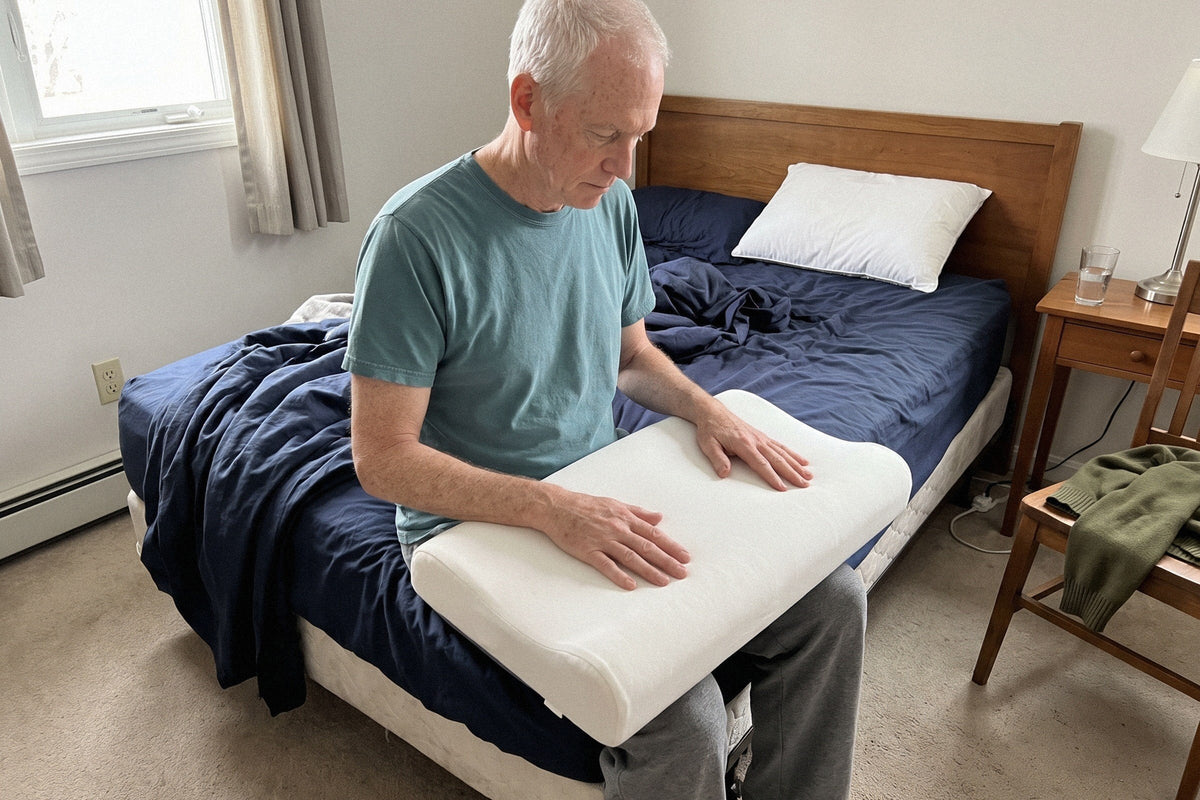
This is the Seat cushion and lumbar set, and in this guide's order it is the step after getting up. We make it as two pieces, a seat cushion and a lumbar pillow, one matched set. Both pieces use natural-rubber memory foam with a slow rebound, not too soft, not too firm. The seat cushion has a center cutout that lifts the tailbone off the chair. The lumbar pillow is the back piece that fills the small of the back. Each piece has a breathable cover with airflow cutouts, and both covers unzip and wash.
It makes sense once getting up is a habit and your chair still leaves a gap at the small of your back. It does not get you out of the chair, and it is not a fix for a back that hurts.
Before you go: get emergency care for back pain after a serious accident, with pain, tingling, weakness or numbness in both legs, or with bladder or bowel changes. Ask a health professional about pain that has not improved after a few weeks of caring for it at home, or after resting. For more on sitting at work, browse all our Office guides.
Quick answers
OSHA shows standing as a neutral working position, but says working in the same posture for prolonged periods is not healthy. In one small study, office workers with a higher body weight switched between sitting and standing every 30 minutes, not standing all day. We read a standing desk as a way to change position, not to stand still.
Back pain with pain, tingling, weakness or numbness in both legs, or bladder or bowel changes, needs emergency care, whichever position hurts more. This guide does not explain the reverse pattern. If you are worried about the pain, or it has not improved after a few weeks of caring for it at home or after resting, ask a health professional.
Sources
- Don't take back pain sitting down, Harvard Health Publishing, 2023
- Back pain, NHS, 2026
- Comparison of In Vivo Intradiscal Pressure between Sitting and Standing in Human Lumbar Spine: A Systematic Review and Meta-Analysis, Life (Basel), 2022
- eTools : Computer Workstations - Positions, Occupational Safety and Health Administration (OSHA), 2026
- Breaking up workplace sitting time with intermittent standing bouts improves fatigue and musculoskeletal discomfort in overweight/obese office workers, Occupational and Environmental Medicine, 2014
- eTools : Computer Workstations - Workstation Components - Chairs, Occupational Safety and Health Administration (OSHA), 2026