Can't Sleep the First Night Away? What's Going On
What sleep studies found about the first night somewhere new, and a plan for your next hotel or guest room.


Key takeaways
- In sleep studies, the first night in a new setting went worse than a later night in the same place.
- A newer study saw the first-night dip at home too, so your own bed may not be the whole story.
- If you can, stay more than one night, and put the long drive or the big day after night two.
- Drowsy at the wheel? Pull over in a safe place, such as a lighted rest stop, for a short nap.
- If you regularly have problems sleeping, at home or away, ask a health professional.
Trouble sleeping the first night in a new place has a name in sleep research: the first-night effect. In studies, sleep on the first night was shorter and more broken than on a later night. Plan around a rough first night, keep your usual wake-up time, and ask a health professional if you regularly have problems sleeping.
What happens to your sleep the first night away?
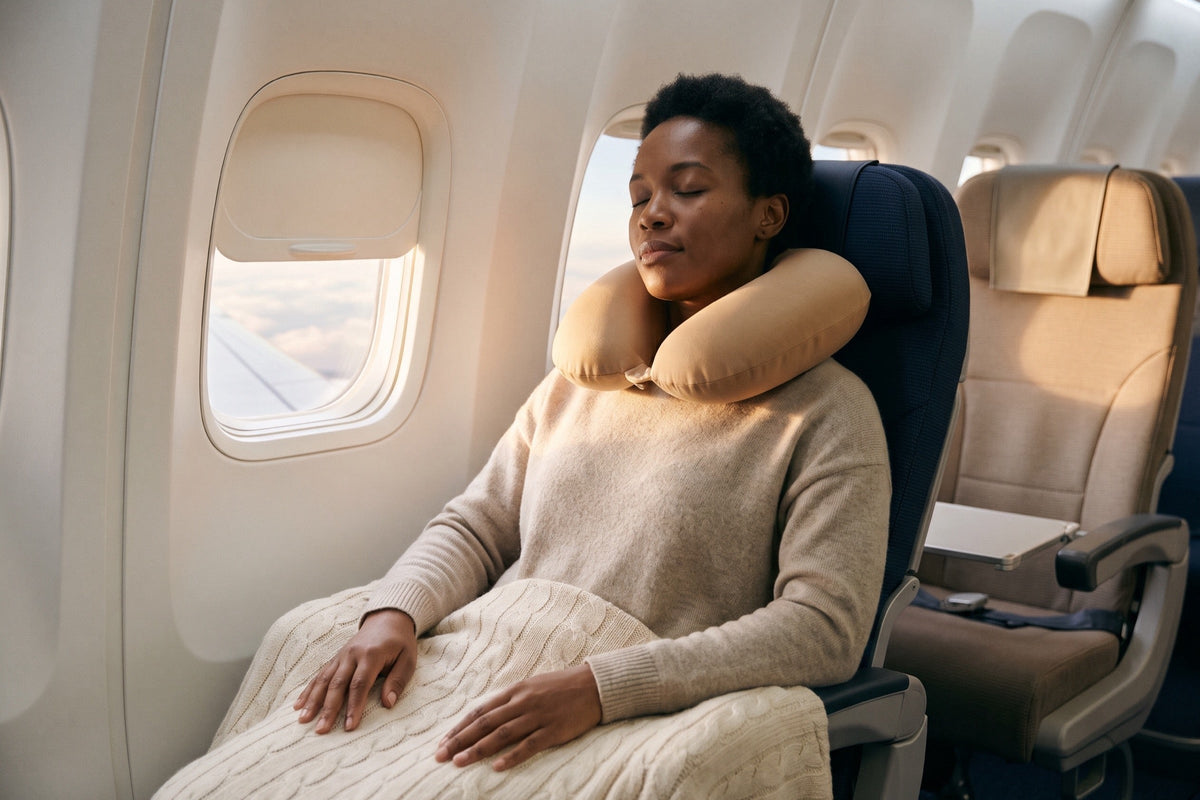
The first-night effect is the poorer sleep recorded on a first night in a new sleep setting, compared with a later night: longer to fall asleep, more time awake after dropping off, less sleep overall. You may know it from a holiday trip such as Thanksgiving. The travel day is done, the guest room is quiet, the sheets are clean, and everyone else in the house is asleep. You are worn out and still awake, hearing every small sound.
The night-watch study, an older paper on sleep in each half of the brain, starts from that same experience: "We often experience troubled sleep in a novel environment."1 The authors add that this is called the first-night effect in human sleep research.1 In a newer study from the University of Fribourg, the first night hit three measures most: time awake after first falling asleep went up, the wait to fall asleep grew, and total sleep fell.2
As we read them, these studies found the weaker first night without any long travel day, and nothing in them suggests that being worn out from the trip makes it go away.
Why it happens is not settled. The night-watch team saw one half of the brain sleep less deeply on a first night,1 and the Fribourg team found that unevenness on other nights too, not tied to the first one.2 If you are lying awake right now, these studies offer no trick for this hour. What they do show is that the later night went better on average,2 and the plan at the end builds on that. This guide names no condition and suggests no sleep aid.
Does half your brain really stay on watch?
You may have heard it in a short video or a late-night thread: in a new place, half your brain stays awake. The line traces back to a real study, and the study says less than the line does.
What the night-watch study found
The night-watch study enrolled 35 young, healthy people in total, across three experiments.1 Each experiment had two sleep sessions about a week apart, and the second and third experiments each used a new group.1
In the first group, during the first session, sleep was less deep in one half of the brain than in the other. The difference sat in the default-mode network, which the authors describe as "involved with spontaneous internal thoughts during wakeful rest."1 The bigger that difference, the longer people took to fall asleep.1
In a second group, rare odd beeps were mixed in among frequent regular ones and played into one ear while people slept.1 The less deeply sleeping half showed a stronger brain response to the odd beeps, and odd beeps it picked up led to more arousals from sleep.1 A third group was asked to tap their fingers lightly when they heard sounds in their sleep, and odd beeps picked up by that half brought faster responses.1 None of these differences showed up in the later session.1
The authors offer their explanation as a hypothesis. Their evidence, they write, is "in accord with the hypothesis that troubled sleep in an unfamiliar environment is an act for survival," with one half of the brain kept partly more alert than the other as a night watch.1 The limits belong right beside it: the volunteers were young and healthy, the team measured brain activity only during the first sleep cycle, and the paper is an older one.1 Grants from the National Institutes of Health and the National Science Foundation funded the work, and the authors declare no conflict of interest.1
What a newer study could not confirm
The Fribourg team also looked at uneven deep sleep between the two halves of the brain in its volunteers. In its results, the degree of that unevenness "was not correlated with" the first-night effect and tended to vary over several nights.2 The university's release says the uneven sleep patterns showed up every night, not just during the first-night effect.3
We read the half-brain story as one team's explanation, and a newer study did not find the link it depends on. Both teams start from the same weaker first night; they differ on why it happens.
Is it the bed, the pillow or the room?
Lying there, you start blaming things. The pillows feel wrong, the mattress is softer than yours, the air smells different, and the heat clicks on and off. One team put that suspicion to a test, with first nights in a sleep lab and first nights at home.
What the lab and home nights showed
The team, at the University of Fribourg in Switzerland, ran two studies, published in the journal Sleep. In the first, 45 healthy participants spent two nights in the sleep laboratory, a week apart.2 In the second, 30 participants spent two nights in the lab and two at home,2 again with each night a week apart.3 Electrodes were attached before people either went home or stayed the night in the lab.2
The result, in the paper's words: "Sleep disturbances in the first night happen in both familiar and unfamiliar environments."2 The authors conclude that familiarity with the environment "may not be sufficient" to soften a first night, since the effect also showed up at home.2 The university's release names two things that can affect sleep quality: the unfamiliar environment, like a new room or bed and unfamiliar noises, and the situation, like being connected to recording equipment.3
Home still came out ahead: "Overall, participants slept better in their home environment than in the sleep laboratory."2 That comparison has a catch the authors name themselves, since time in bed was capped in the lab and not at home.2
Who took part, and what that means
The volunteers were young and healthy, most of them women, recruited through a newsletter to psychology students and through online ads.2 The authors note that the unbalanced sex ratio casts doubt on how broadly the findings apply.2 Half the group slept the lab nights first and half the home nights first, in random order, and at home people still slept wired to the recording equipment.2 So a home night in this study was not an ordinary night either. The European Research Council funded the work, and the authors report no financial or non-financial disclosures.2
Our reading rests on both findings at once. Home went better overall, yet the first night was still the weaker one there too. So a familiar bed or pillow cannot be counted on to change the first night, and we found no test of bringing bedding from home in these studies. The room still matters for sleep in general, and we come back to it below.
Will the second night be better?
Somewhere in the dark, the math starts: if I do not sleep tonight, tomorrow is gone. It helps to know what studies saw on the night after, and what they cannot tell you.
In a separate two-night study, 92 healthy adults had their sleep recorded on two consecutive nights.4 Night one brought less total sleep, a smaller share of time in bed spent asleep, and more time awake after first falling asleep than night two.4 In the night-watch study, too, none of the first-night brain differences showed up in the later session.1 The two-night study's authors declare no competing interests.4
The Fribourg work stretched the gap between nights, and the first-night effect still happened even when the nights were not consecutive.3 We read that as a sign that a first night in a place seemed to carry over: the next night there, even a week later, still went better. In the university's release, one of the study's authors turns the finding into travel advice: "If you're planning a trip, try to stay more than one night," or go back to places where you have already slept.3
These are group averages from healthy volunteers wearing sensors, and no study we read followed holiday travelers in a hotel or a guest room. A group finding is not a forecast for you. A group average also leaves room for a rough second night, by our reading of how averages work.
What can you change in a hotel room or guest room?
By now you have noticed everything in this room. A small fridge hums. A line of light shows under the door. The wall unit kicks on, then off, and in between it is the wrong kind of quiet. In a relative's house, even getting up to move something feels awkward.
In two of the night-watch study's experiments, sounds were played to sleepers, and the less deeply sleeping half responded more strongly to rare odd beeps among regular ones, played into one ear.1 A creak in a hotel hallway may feel a little like those beeps, but a beep in a sleep study is not a door down the hall; the comparison is our reading, not a finding about hotels or homes.
The CDC's habit for the room itself is this: "Keeping your bedroom quiet, relaxing, and at a cool temperature."5 Inside a room you did not choose, these are the small, untested steps we would take:
- Close the curtains, or turn a bright lamp away from the bed.
- If the room has its own thermostat or wall unit, set it a little cooler before bed.
- Keep your usual bedtime steps, in their usual order.

If a fan or another steady sound is part of your nights at home, it may be worth bringing along. In what we read of these studies, none tested a fan or a steady background sound as a way to sleep better on a first night.
What helps on the first evening away?
Dinner ran late, coffee came with dessert, and the house is still talking. By the time you reach your room, the evening has already made some choices for you.
The way we see it, a shorter, more broken first night may come whatever you do, which makes the evening the part you can steer. The CDC's list of habits that can improve your sleep includes these four:5
- Going to bed and getting up at the same time every day.
- Avoiding caffeine in the afternoon or evening.
- Avoiding large meals and alcohol before bedtime.
- Turning off electronic devices at least 30 minutes before bedtime.
These are the CDC's habits for sleep in general. The CDC does not tie them to a first night away, and we found no study in this guide that tested them on one.
For a holiday table, a few thoughts of our own. When the big meal comes early in the day, it is already well clear of bedtime. Keep your usual wake-up time even if the house sleeps in, since the first habit on the list is the same times every day. And if coffee came with dessert tonight, tomorrow's afternoon cup is the one you can still skip.
How do you plan the day after a short first night?
Morning means the drive to the next house, the flight home, the dinner you said you would cook. The first night may have been short, and you still need to function.
When you can choose, put the long drive or the day that matters after night two rather than night one. That is our suggestion, built on two findings: night two went better on average in the two-night study,4 and the Fribourg release advises more than one night in a new place.3
If you have to drive, NHTSA is direct: "Getting adequate sleep on a daily basis is the only true way to protect yourself against the risks of driving when you're drowsy."6 The same page says to get a good night's sleep before the start of a long family car trip.6 As we read those two lines, a drive the morning after a first night away may follow a short night, so build in time to pull over if you need to.
If drowsiness shows on the road, NHTSA says to pull over for a short 20-minute nap in a safe place, such as a lighted, designated rest stop.6 For what to watch for behind the wheel, and what the open window and the radio can and cannot do, read our guide to staying awake on the drive and knowing when to stop.
When is it more than a new place?
Maybe the real worry is this: what if it is not the room, because it happens at home too? That question deserves a straight answer, without guessing at a cause.
The CDC lists signs of poor sleep quality, including these:5
- Trouble falling asleep.
- Repeatedly waking up during the night.
- Feeling sleepy or tired even after getting enough sleep.
The CDC's advice is plain: if you regularly have problems sleeping, ask a health professional.5 In our reading, a rough first night in a new place is what the studies here recorded in healthy volunteers, while regular problems sleeping, at home or away, are the CDC's reason to ask.
If tiredness stays after you are back home, our guide to feeling tired after a full night in your own bed walks through reading your nights, with its own warning signs. On the road, the line is simpler: drowsy at the wheel means pull over in a safe place, not push on.6
What this cannot fix
This guide cannot make a new room feel like home, quiet a full house or tell you why you in particular sleep badly when you travel. The studies here recorded the sleep of healthy volunteers for only a few nights each. They were young people in the night-watch study,1 young adults in a lab and at home,2 other adults on two nights in a row,4 and school-age children at home.7
None of them followed holiday travelers in a hotel or a guest room, and their findings are group averages, not a forecast for your next trip. Nothing in this guide, from a bed or a blanket to a steady sound, is shown here to change the first night. The CDC habits are habits for sleep in general, and the CDC does not tie them to a first night away.
A short night before a drive is a safety question: if drowsiness shows, pull over in a safe place.6 And if you regularly have problems sleeping, at home or away, ask a health professional.5
What should your first two nights away look like?
This is the plan we would follow on a holiday trip, from the days before you leave until you are back home. Where a step goes past its source, it says so.
- Keep your usual bedtime and wake-up time in the days before you leave, and hold them through the trip.5
- Book more than one night if you can, or a place where you have slept before.3 Set the long drive or the big day after night two (our suggestion), and settle both when you plan the trip.
- Skip caffeine in the afternoon and evening, skip large meals and alcohol before bedtime, and turn off electronic devices at least 30 minutes before bedtime, starting on the first evening.5
- Make the room as quiet and cool as you can without rearranging anything,5 and darker if the curtains allow (our addition), before you turn out the light.
- On night one, plan for a shorter, more broken night,4 and hold off judging the trip until night two is behind you.
- Pull over in a safe place for a short nap if drowsiness shows on the drive the next morning.6 Back home, ask a health professional if you regularly have problems sleeping, at home or away.5
The first night is the one these studies flagged in healthy volunteers. In our view, it is not a verdict on you or on the trip. If a holiday trip puts you in a guest room, give the second night its chance before you decide anything about the visit. More of our travel guides are on the Travel guides page.
(*) This guide shares general information, not medical advice, and it does not replace a visit with a health professional.
Quick answers
One of the authors of a Swiss sleep study suggests it: stay more than one night on a trip, or go back to places where you have already slept. In that study, the second lab night went better on average, even a week after the first. No study we read tested a gap as long as a year.
In a home study of 41 healthy school-age children in Singapore, the authors call the effect modest: slightly more night waking and a later start of REM sleep, with no difference in total sleep time. No study we read followed children away from home. If you regularly have problems sleeping, the CDC says to ask a health professional.
Sources
- Night watch in one brain hemisphere during sleep associated with the first-night effect in humans, Current Biology, 2016
- The first-night effect of sleep occurs over nonconsecutive nights in unfamiliar and familiar environments, Sleep, 2024
- Why do we sleep poorly in new places?, University of Fribourg, 2024
- Sleep microstructure correlates of the first-night effect: sleep spindles and slow-wave activity in healthy adults, Sleep and Breathing, 2026
- About Sleep, Centers for Disease Control and Prevention (CDC), 2024
- Drowsy Driving, National Highway Traffic Safety Administration (NHTSA), 2026
- Modest first night effect on sleep in healthy school-age children using home-based polysomnography, Sleep Health, 2026