Neck Pain at Work? Look at Your Night, Not Just Your Desk and Your Phone
Warning signs first, then your desk, phone, bed and pillow, and what research does and does not show about each.


Key takeaways
- Health pages list desk time, screen height and sleeping position as everyday contributors, not as one cause.
- A stiff neck with fever, confusion or extreme sleepiness needs emergency care first.
- In one year-long study, phone neck angle did not predict neck pain, but low sleep quality did.
- We did not find a study of phone use in bed and neck pain, or of a pillow against desk pain.
- Log your neck on waking and mid-afternoon, and change one thing at a time.
Neck pain at work has several everyday contributors, not one known cause. Health pages list bending over a desk, a screen too high or low, and an uncomfortable sleeping position. In one year-long study, low sleep quality went with later neck pain; phone neck angle did not. A stiff neck with fever, confusion or extreme sleepiness needs emergency care.
What is neck pain at work?
Neck pain at work is soreness or stiffness in the neck that you notice during the workday. Maybe it shows up mid-afternoon: someone says your name from behind, and you turn the whole chair instead of your head. The first guess is the desk.
The health pages partly agree. MedlinePlus lists bending over a desk for a long time, a computer monitor positioned too high or too low, and sleeping in an uncomfortable position among everyday contributors to neck pain.1 Cleveland Clinic, on stiff necks, lists "sleeping on your neck in an unusual position, looking at a screen for too long and even extra stress."2
Neither page ranks these or says which applies to you. This guide names no cause either, and nothing in it replaces asking a health professional. It goes in order: the warning signs, then your desk, your phone, your sleep, the phone in bed, the pillow, and what to change first.
When is it more than a sore neck?
It may feel like a hard week at the desk. First, two short lists: they name signs, not conditions, and tell you when to stop reading and get help.
Get emergency care
Cleveland Clinic: "Go to the emergency room if you have a stiff neck and other symptoms like:"2
- Nausea or vomiting
- Fever
- Light sensitivity
- Confusion
- Lack of energy, extreme sleepiness or trouble staying awake
- Lack of appetite
- Small, round spots that look like a rash
MedlinePlus adds two signs under "Seek medical help right away if you have:"1
- A fever and headache, and your neck is so stiff that you cannot touch your chin to your chest: call 911 or the local emergency number or get to a hospital.
- Shortness of breath, sweating, nausea, vomiting, or arm or jaw pain.
Ask a health professional
MedlinePlus lists these under "Contact your provider if:"1
- Symptoms do not go away in 1 week with self-care
- You have numbness, tingling, or weakness in your arm or hand
- Your neck pain was caused by a fall, blow, or injury: if you cannot move your arm or hand, have someone call 911 or the local emergency number
- You have swollen glands or a lump in your neck
- You have difficulty swallowing or breathing along with the neck pain
- The pain gets worse when you lie down or wakes you up at night
- You have trouble walking and balancing
- You lose control over urination or bowel movements
Cleveland Clinic adds: "Visit a healthcare provider if you're having trouble moving your neck and the stiffness lasts more than a few days."2
Pain that wakes you at night or gets worse when you lie down is a stop item, not a pillow experiment. The two pages draw their lines at a few days and at a week, so when unsure, ask sooner.
 Neck & SpineMorncrest® Cervical Pillow Pro
$89
Does a long day at the desk matter for your neck?
What about sitting and your screen?
Picture the hours after lunch, bent over the desk toward a monitor positioned too high or too low: both are on the MedlinePlus list.1
One study followed 1,334 workers over time.3 Its authors concluded that sitting at work for almost the whole working time "seems to be a risk factor for neck pain," with only a trend, not a clear link, for bending the neck forward.3 That is an association; the abstract does not rule out other explanations.
Does a better setup help? In people without neck pain at the start, a review found low-quality evidence that ergonomic programs do not reduce the risk of a new neck pain episode.4 No review we read shows a better setup removes neck pain, so this guide gives no sitting interval, chair setting or desk-setup recipe.
What about your phone and your head position?
Then the other screen: between meetings your head tips forward over your phone, a posture people call "tech neck." It is a popular label; neither the MedlinePlus neck pain page1 nor the Cleveland Clinic stiff neck page2 uses it.
The closest test of the phone question we found is a follow-up of adults who began without neck pain. Its title gives the result: "Cervical flexion posture during smartphone use was not a risk factor for neck pain, but low sleep quality and insufficient levels of physical activity were."5
It is one study, an association, and silent on office work: the abstract does not say what participants did for a living. We are not telling you to ignore your angle, only that it did not predict neck pain there. Of the two things that did, one happens after the laptop closes.
Does how you sleep show up in your neck at work?
Sleep happens hours away from your desk. In the same study, 396 participants completed the one-year follow-up, and low sleep quality was a risk factor for neck pain; low physical activity comes back later.5 Sleep quality came from one self-reported question: "Did you have trouble sleeping in the last month?"5 It is an association in people who started without neck pain. A follow-up shows what came first, not why, and the abstract reports on sleep quality, not position.
As for position, MedlinePlus lists sleeping in an uncomfortable position1 and Cleveland Clinic sleeping on your neck in an unusual position.2 Neither page names one.
One small study surveyed 53 participants and filmed them over two nights.6 In general, those with waking spinal symptoms "spent more time in provocative sleep postures, and experienced poorer sleep quality."6 It looked at one point in time, "spinal" includes the lower back, and it cannot show which came first. We did not find a study that follows sleeping position and neck pain over time.
For your own bed, our stiff neck guide lays out the bed check in order, from your position to the mattress. Before sleep, though, the day may end in another position: propped up, phone in hand.
Does your phone follow you into bed?
The lights are low. You are propped on pillows with the phone held up near your chest, or on your side with the screen close. Is this part of the neck you carry to work the next day?

We looked for a study that follows phone use in bed against neck pain and did not find one. So we cannot say it is part of your neck pain, or that it is not. The closest evidence is the follow-up study above: the neck angle during phone use did not predict neck pain, and low sleep quality did.5
Our reasoning, and only ours: the useful questions about the phone in bed are what it does to your night (when you fall asleep, how often you wake) and how your neck feels on waking. The log below has a place for both.
Where does a pillow fit in?
Wondering about your pillow? It comes last, and no sign from the lists above is a pillow problem. A systematic review of pillows in people with chronic neck pain found five studies that met its criteria,7 and differences in sleep quality scores were not statistically significant.7 Its authors add that "high heterogeneity in study designs, outcome measures, and pillow characteristics limits definitive conclusions."7
No study named in this guide tested our pillow, and we found no source that tests a pillow against neck pain that builds during a workday. A pillow is one thing to check, not a known cause and not a known fix. Still, we think it is worth a look: it sets how high your head sits, and that can be changed on purpose.
That is the part we make. Our Cervical Pillow Pro has a high side and a low side, so a height change is a flip. Start on the high side if you sleep on your side or have broad shoulders. Flip to the low side if you sleep on your back with a smaller frame, or on your stomach. If neither description fits you, or both do, start on either side and give each a few nights. Settling in takes 3 to 7 nights, and the first nights can feel unfamiliar, so one night says little about the height.

A height change affects how high your head sits and nothing else about the night.
What should you change first?
The urge is to fix it all this weekend: new chair, new phone habit, new pillow. Then a better week cannot be traced to any of it.
Change one thing at a time, and keep our log: one word for your neck (none, mild or bad) at two moments a day. On waking, add how you slept and whether the phone was in bed; mid-afternoon at your desk, a note on the day:
- Waking: mild. Slept badly, phone in bed until late.
- Mid-afternoon: bad. Back-to-back calls, barely left the chair.
Read it over several workdays and several nights, never one day. The order below is ours and goes by effort, not medical need:
- The workday. Move during the day and check whether your screen sits too high or too low. In people without neck pain at the start, a review found moderate-quality evidence that an exercise program may reduce the risk of a new episode of neck pain.4 That covers new episodes, not a neck that already hurts; a health professional can help you choose a program. Give this step several workdays and several nights in the log.
- The phone. Our idea, not a finding: change where it spends the night, and watch the morning line for the same span.
- The bed. Run the bed check from the stiff neck guide, for the same span.
- The pillow. Last: change only the height under your head, for the same span.
The log's two halves loosely follow the study above, where low sleep quality and low physical activity went with later neck pain.5 If the mornings keep pointing at your sleep, see our guide on how to read your own nights.
Sleep tip
Note your neck at the same two moments every day, when you wake and mid-afternoon at your desk, so any two days can be compared.
The lists near the top come first: emergency signs go to emergency care, and pain that wakes you or worsens lying down goes to a health professional.
What this cannot fix
A pillow does not change a desk, a screen, a phone habit, the hours you sit, or the extra stress Cleveland Clinic lists alongside screen time and sleeping position.2 None of the signs in the lists near the top is a pillow problem. Pain that wakes you at night or gets worse when you lie down is for a health professional, not a different pillow.
We cannot tell you why your neck hurts at work, and no source we read names one cause. If the height under your head already suits you, a different pillow has nothing to change, and ours is no exception.
If your symptoms do not go away in 1 week with self-care,1 or you have numbness, tingling or weakness in an arm or hand, ask a health professional and bring the log. A stiff neck with fever, confusion or extreme sleepiness is for emergency care first.
Which pillow is this?
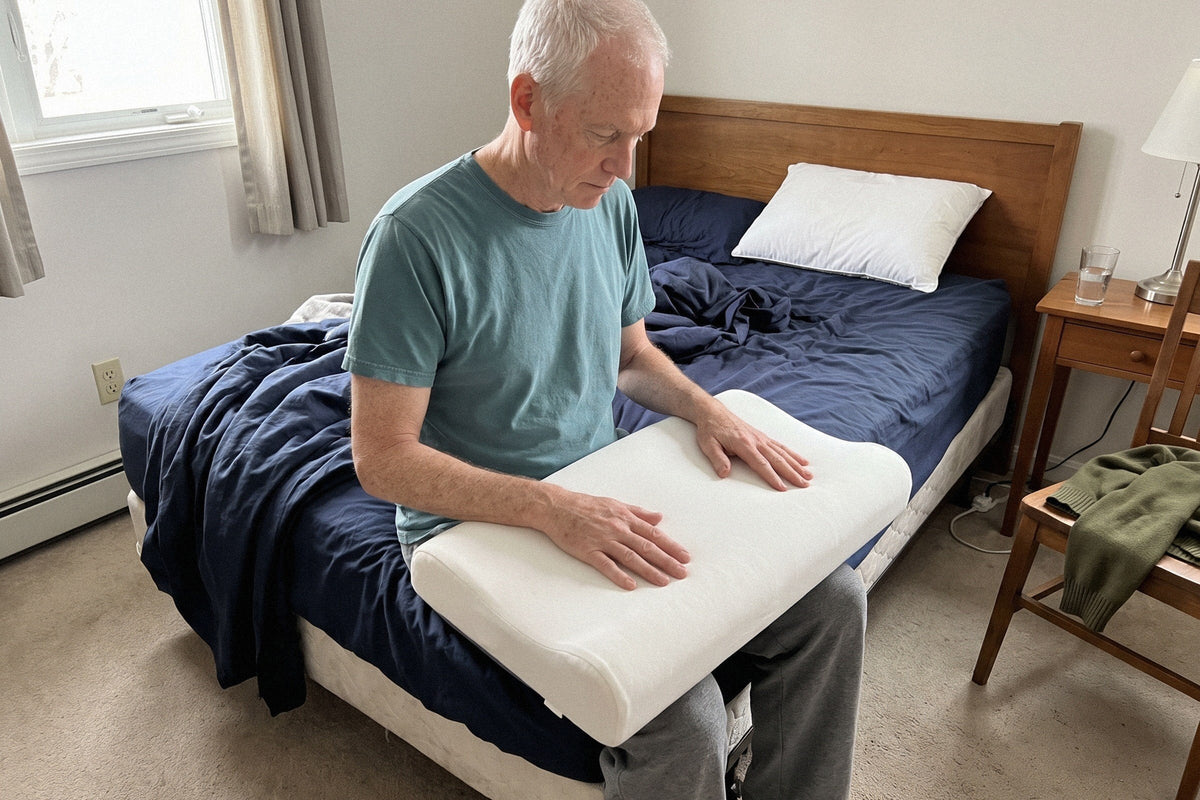
This is our Cervical Pillow Pro, made for anyone who wants to set the height under their head and change it later. A flip moves you between its 10 cm high side and its 8 cm low side.
Four zones shape it: a head cradle, raised side wings, a neck-to-shoulder curve and arm room. The natural-rubber memory foam is slow-rebound with a medium feel, so it gives under your head over a few seconds, then holds. The cotton cover is soft, breathable and removable. Colors: Midnight Blue or Light Gray.
It sets the height under your head at night and nothing more, and it is not a fix for neck pain that builds at your desk. A stiff neck with fever, confusion or extreme sleepiness is for emergency care; neck pain that lasts or comes with numbness, tingling or weakness in an arm or hand is for a health professional. For more, see the rest of our Sleep guides.
Quick answers
The pages we read name no single cause. MedlinePlus lists bending over a desk and a monitor set too high or too low, and both it and Cleveland Clinic list an uncomfortable or unusual sleeping position. Check whether your neck is already stiff when you wake. A stiff neck with fever, confusion or extreme sleepiness is for emergency care.
Not on the pages we read. It is a popular label for the head-forward posture over a phone. One study's authors note the posture is commonly referred to as text neck. The MedlinePlus neck pain page and the Cleveland Clinic stiff neck page use neither term. In that study, neck angle during phone use did not predict neck pain.
We found no source that tests a pillow against neck pain that builds during a workday. A pillow sets the height under your head at night. Our Cervical Pillow Pro has a high side and a low side, and settling in takes 3 to 7 nights. If pain lasts, ask a health professional.
Sources
- Neck pain, MedlinePlus (National Library of Medicine, NIH), 2026
- Stiff Neck, Cleveland Clinic, 2026
- Are neck flexion, neck rotation, and sitting at work risk factors for neck pain? Results of a prospective cohort study, Occupational and Environmental Medicine, 2001
- Exercise programs may be effective in preventing a new episode of neck pain: a systematic review and meta-analysis, J Physiother, 2018
- Cervical flexion posture during smartphone use was not a risk factor for neck pain, but low sleep quality and insufficient levels of physical activity were. A longitudinal investigation, Braz J Phys Ther, 2025
- Examining relationships between sleep posture, waking spinal symptoms and quality of sleep: A cross sectional study, PLoS One, 2021
- Effect of pillow on pain, disability and sleep quality in patients with chronic neck pain: A systematic review, Rehabilitacion (Madr), 2025