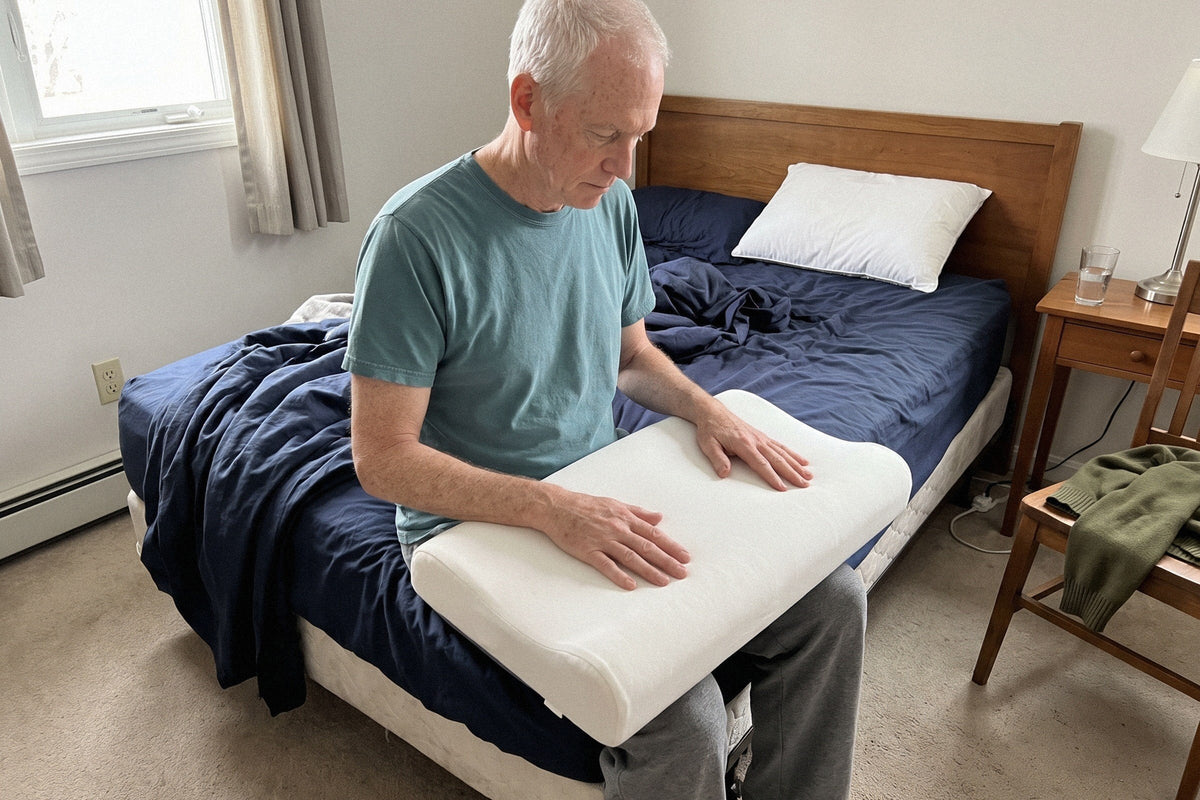
Pillow Too High or Too Low? What Your Half-Asleep Habits Hint At
What folding, stacking and an arm under the pillow can and cannot tell you, and a check you can run alone tonight.


Key takeaways
- Too high holds your head above the line of your body; too low lets it sit below, health pages say.
- Folding, stacking or an arm under it adds height, which we read as a hint it feels low; we found no study.
- A habit is a hint, not a verdict; the check, in the position you wake up in, shows where your head sits.
- A stiff neck with fever needs emergency care. Pins and needles or a cold arm: ask a health professional.
- Make one change at a time; with a two-height pillow, that change is a flip.
Your pillow is too high if your head sits above the line of your body and too low if it sits below, health pages say. Folding it, stacking another pillow or an arm under it adds height, which we read as a hint it feels low; we found no study. A stiff neck with fever needs emergency care.
What does too high or too low actually mean?
A pillow that is too high or too low is one that holds your head above or below the line of the rest of your body while you sleep. Some nights the same pillow feels fine. Other nights you fold it, flatten it and flip it over half asleep, and still cannot tell whether you need more height or less.
The health pages we read describe that line, not a number. Ohio State says too much lift "could hold your head above your body and put stress on your neck joints," while too little lets your head sit too low compared to your body.1 Cleveland Clinic's rule of thumb is a pillow that keeps your neck "parallel to the mattress, rather than bent down or up."2 The NHS puts it plainly: "when sleeping, make sure your head is the same height as the rest of your body."3 Ohio State adds that "there's no perfect recommendation on pillows."1
So this guide sets no target height in inches or centimeters. Warning signs come first, then the habits, a check to run alone, why nights differ and what to change first. We name no cause for your neck, and nothing here replaces asking a health professional.
When is it more than a pillow problem?
When your neck is sore, the pillow is the easy suspect, but some signs should not wait on any pillow change. The lists tell you when to act, not what you have.
Get emergency care
Cleveland Clinic: "Go to the emergency room if you have a stiff neck and other symptoms like:"4
- Nausea or vomiting
- Fever
- Light sensitivity
- Confusion
- Lack of energy, extreme sleepiness or trouble staying awake
- Lack of appetite
- Small, round spots that look like a rash
Ask a health professional
- Cleveland Clinic: "Visit a healthcare provider if you're having trouble moving your neck and the stiffness lasts more than a few days."4
- The NHS: "neck pain or stiffness does not go away after a few weeks."3
- The NHS: "you have other symptoms, like pins and needles or a cold arm."3
Pins and needles or a cold arm on waking is a reason to ask, not a pillow experiment, even if your arm spent the night under the pillow. If you are unsure, ask sooner rather than later. Woke up stiff this morning? Our stiff neck guide covers what to do with a stiff neck today and tonight.
 Neck & SpineMorncrest® Cervical Pillow Pro
$89
Which habits do retail pages read as pillow height signs?
Some mornings the evidence is right there: the pillow folded in half, a second one dragged in, your arm buried underneath, and no memory of doing any of it. Pillow sellers' pages list habits like these as signs of the wrong height:
- Folding or bunching the pillow
- Stacking a second pillow
- Sleeping with a hand or an arm under the pillow or your head
- Waking with the pillow pushed away, or with only the back of your head on it
- Waking up on your stomach
- Readjusting, fluffing and flattening it through the night

The pages we read give no source for these signs. We searched PubMed and Europe PMC, databases of medical studies, for folding, stacking, an arm under the pillow and readjusting, and did not find a study of them as signs of pillow height. In this guide they are clues, not a verdict.
Which way these habits point is our reading, not a finding:
- Hints the pillow feels low: folding, stacking and an arm underneath all add height.
- Hints the pillow feels high: pushing it away, sliding down until only the back of your head is on it, and pressing it flat take height away.
Readjusting both ways can mean the pillow suits one of your positions and not another. A habit can also be only a habit: some people tuck an arm under any pillow. Read it as a direction, and let the check below show where your head sits.
How do you check your pillow height on your own?
Nobody watches you sleep, and from the pillow you cannot see your own neck, so this check works from feel.
- Lie down in the position you most often wake up in. Our suggestion, not a source's: you know you held that one, while the position you fall asleep in may not last the night.
- Let your neck go loose for a few moments. A head you hold up on purpose is not resting on the pillow yet. Then notice where it settles against the line of your body, using the notes below.
- Hold what you noticed against your habit. If both point the same way, you have a direction to change. If not, or if your head already sits level, the pillow may not be the part to change.
What to notice in each position
On your back, Ohio State says the right height keeps your head from being pushed forward by the pillow or forced to reach for it.1 A chin pressed toward your chest reads as above the line, and Cleveland Clinic says sleeping with your chin to chest can overstretch your neck.2 A chin that lifts as your head tips back reads as below.

On your side, Ohio State says to have enough height to bridge the gap created by your shoulder.1 A head tipped down toward the mattress reads as below the line; one pushed up toward the ceiling, above.
On your stomach, Ohio State calls the position generally not recommended because your head is rotated, and suggests a short-height pillow if you sleep that way.1 The NHS says do not sleep on your front.3
This is a rough feel check. It measures nothing and shows a direction, never a cause.
Sleep tip
Run this check again after any change to your mattress or topper, because the bed under your shoulder is part of where your head ends up.

Why does the same pillow feel wrong only some nights?
Fine on Monday, pushed away by Wednesday, and the pillow looks the same. Something around it may have changed instead.
You change position
Maybe you split the night between side and back. Ohio State asks for enough height on your side to fill the space your shoulder leaves, and on your back for a height that does not push your head forward.1 We infer that a height that suits your side can sit above the line once you roll onto your back.
Your mattress
Cleveland Clinic says, "If you have a firmer mattress, you'll need a thicker pillow because your shoulder won't sink into the mattress very much."2 With a pillow-top mattress, it says, "you'll need a thinner pillow because your shoulder will sink into the bed."2 That is why, in our view, a new mattress or topper can move a pillow that used to fit, and a softer bed can call for a lower one.
The pillow itself
A pillow gone flat or lumpy no longer holds its old height, and the change can be slow enough to miss; we say that without a source. Ohio State says "there's no definitive source on when to replace your pillow."1
The day before
Cleveland Clinic lists sleeping on your neck in an unusual position, looking at a screen for too long and even extra stress among common contributors to a stiff neck.4 One sore morning after a hard day says little about the pillow. If your neck aches by afternoon too, our guide to neck pain at work explains how the day and the night add up.
What should you change first?
After a few rough mornings, the pull is to order a new pillow tonight. A smaller change comes first. Our order, not a medical one: make one change at a time, in the direction your habit and your check agree on. If they disagree, look first at what changed between nights. Keep the rest of the bed the same, so your mornings show what that change did.
- To add height: put a folded towel under the pillow, a common online tip, not a tested method we can point to.
- To take height away: drop the second pillow from the stack, or use a thinner pillow.
The NHS neck pain page says to "use a low, firm pillow,"3 while Ohio State says side sleepers need enough height to bridge the gap created by the shoulder.1 With the pages split, your own check decides. After a change, read your mornings over several nights, never just one, before you change anything else.
We make the Cervical Pillow Pro with two heights, so a change of direction is a flip. Start on the high side if you sleep on your side or have broad shoulders. Flip to the low side if you sleep on your back with a smaller frame, or on your stomach. Our product page puts settling in at 3 to 7 nights for this pillow only, and the first nights can feel unfamiliar. Try each side for a few nights. Once you sleep on it, read the same habit and run the same check: when they agree, they point to the side to flip to. If neither side feels right, height may not be the part to change.
If you have trouble moving your neck and the stiffness lasts more than a few days,4 stop changing things and ask a health professional. A stiff neck with fever, confusion or extreme sleepiness is for emergency care.
A height change sets how high your head sits; we promise nothing else about the night.
What this cannot fix
If you hoped the pillow was the whole story, this is where its part ends. A pillow at the right height cannot change a mattress that sags, the way you lie, a day at a screen, a hard week or the extra stress Cleveland Clinic lists next to a stiff neck.4
The habit signs are clues we found no study of, and the check in this guide is rough: neither can tell you what is behind your neck. If your head already sits level, a different pillow cannot make it more level, and ours is no exception. None of the warning signs near the top of this guide is for a pillow to solve. The NHS page we cite was also past its own next review date when we read it.
If you have trouble moving your neck and the stiffness lasts more than a few days,4 or if neck pain or stiffness does not go away after a few weeks,3 ask a health professional. Ask too if you have pins and needles or a cold arm.3 A stiff neck with fever, confusion or extreme sleepiness is for emergency care first.
Which pillow is this?
The Cervical Pillow Pro is the bed pillow we make for people who would rather choose the height under their head than guess. Its two heights are 10 cm on the high side and 8 cm on the low side; a flip moves you between them, and the side under your head sets the height for the night.
Split the night between side and back? Our own tiebreak: go by the position you most often wake up in, the one you used for the check, and start on the high or low side given for it above. Then read your mornings over several nights.
It is built in four zones: a head cradle, raised side wings, a neck-to-shoulder curve and arm room. The slow-rebound natural-rubber memory foam has a medium feel and gives under your head over a few seconds, then holds. The soft, breathable cotton cover is removable; colors are Midnight Blue and Light Gray.
It sets the height under your head at night and nothing more. It is not a fix for a neck that hurts. A stiff neck with fever, confusion or extreme sleepiness is for emergency care. Trouble moving your neck with stiffness past a few days, or pins and needles or a cold arm, is for a health professional. For more, see our Sleep guides.
Quick answers
Neither. Ohio State says too much lift could hold your head above your body, too little lets it sit too low, and side sleepers need height for the shoulder gap. The NHS neck pain page advises a low, firm pillow, and a health professional if neck pain or stiffness does not go away after a few weeks. Your check decides.
Retail pages call it a sign of the wrong height; we found no study. Our reading: the arm adds height, a hint the pillow feels low, though it can be only a habit. The check in this guide shows where your head sits. Pins and needles or a cold arm: ask a health professional, the NHS neck pain page says.
Flip it to change height. Start on the high side if you sleep on your side or have broad shoulders; flip to the low side on your back with a smaller frame, or on your stomach. Our product page puts settling in at 3 to 7 nights; no study here tested the pillow. Try each side for a few nights.
Sources
- How to choose a pillow, The Ohio State University Wexner Medical Center (Ohio State Health & Discovery), 2024
- Is Your Pillow Giving You a Stiff Neck While You Sleep?, Cleveland Clinic, 2020
- Neck pain, NHS, 2023
- Stiff Neck, Cleveland Clinic, 2026